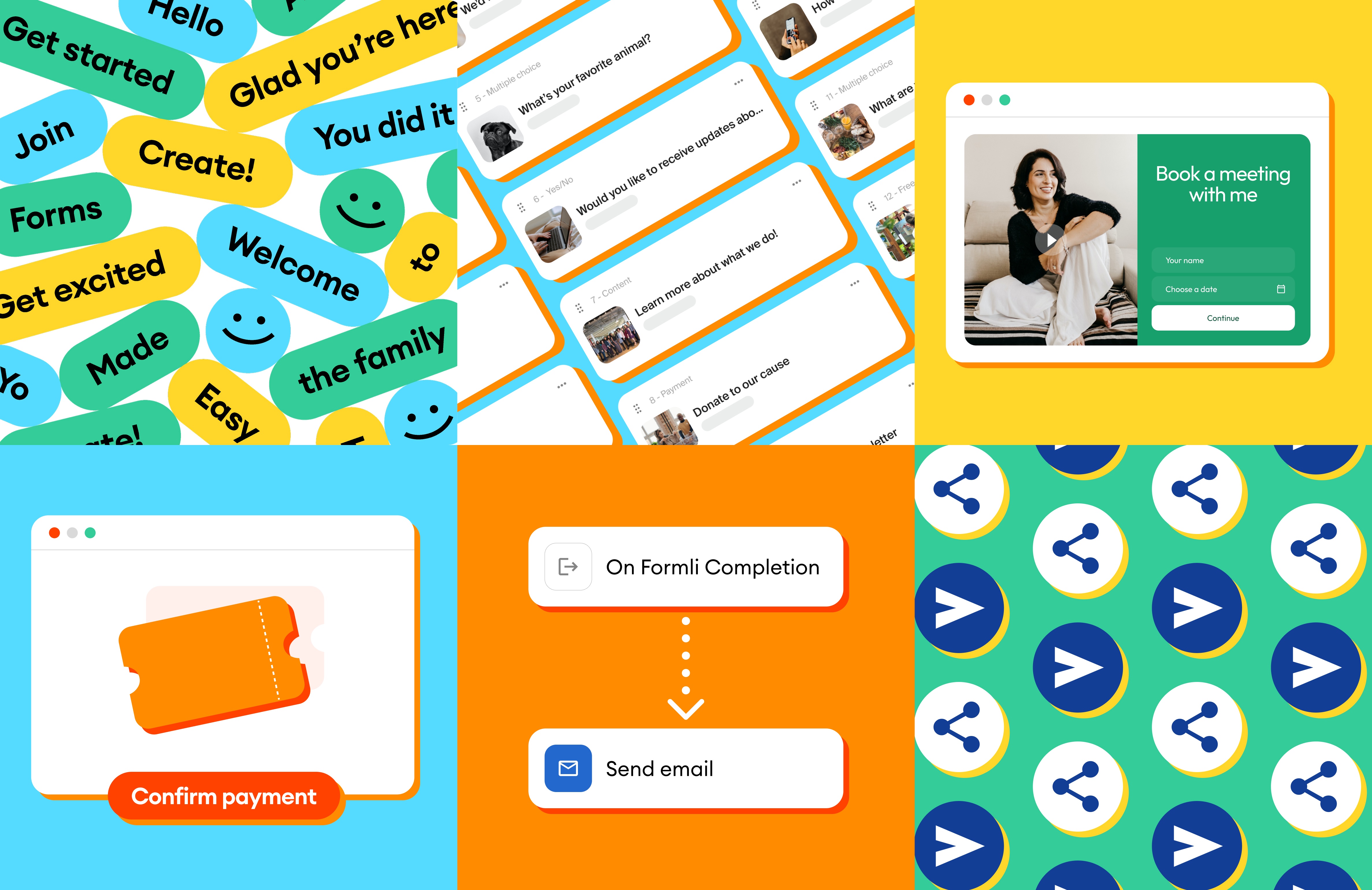
A powerful, mobile-first form builder for everyone.
The following is a summary of the work I led for Formli at Human Agency from 2022 to 2024. As the sole designer for the whole project, I led all product design initiatives. I also revamped the platform website to highlight its features and capabilities.
- Industry
Software as a service
- Team
1 designer (me), 3 developers, 1 QA
- Website


Forms are fundamental to how we interact with technology, from simple button clicks to complex transactions.
In a crowded market of form builders, Formli set out to differentiate itself by prioritizing mobile-first experiences over traditional desktop forms.
Originally designed for political campaigns and nonprofit fundraising, Formli drew inspiration from the engagement patterns of platforms like TikTok and Instagram. The vision: transform static data collection into dynamic, interactive experiences that meet users where they already are—on their phones.
Formli's forms felt basic and lacked customization options and consistent, identifiable patterns.
When I joined in 2022, nearly every client conversation revolved around customization. Organizations needed forms that reflected their brand identity, but our platform couldn't deliver. Questions like "Can we match our button styles?" or "Can we embed video?" became common friction points, revealing a fundamental gap between user expectations and product capabilities.
Project goals:
- Expand customization options (typography, borders, imagery, transitions)
- Evolve the legacy product through incremental, non-breaking improvements
- Establish a robust design system to streamline development handoff and ensure consistency
Balancing innovation with technical constraints.
Working with a small team and legacy architecture meant navigating significant constraints. Formli's editor was built on a rigid three-column layout—foundational to the entire codebase. Any changes risked breaking existing functionality.
Rather than fight this limitation, I reframed it as a design challenge: How can we introduce meaningful customization without requiring a complete rebuild?
This constraint-driven approach forced creative problem-solving and taught me to advocate for long-term vision while shipping incremental value.
![[Fig.2] Formli's legacy 3 columns layout.](/static/e5e0ee95cda66208e8d2d7b05ba0f8d1/29666/legacy.jpg)
Setting up the basis for great collaboration.
When I joined, Formli’s design system covered the basics but wasn’t built to scale or support developer handoff. Since the team relied heavily on MUI, I quickly built a matching Figma library and updated existing designs with real components and styles, helping surface inconsistencies and improve overall UI cohesion.
I also used this onboarding phase to clean up project organization by introducing a simple thumbnail system and clearer naming conventions, making it easier for the team to navigate files and collaborate more efficiently.
![[Fig.3] Example of early Figma file organization.](/static/a0b776b7d7f081b581351307cfb43705/0a581/thumbnails.jpg)
![[Fig.4] Snapshot of Formli's design system.](/static/c43ed0895fa3eb2dc57a215a938043c8/34cf5/components.jpg)
Designing new capabilities while preserving a lightweight, scalable product.
Form customization
Users wanted forms that could visually adapt to their brand and blend seamlessly into any website or product. To support this without impacting legacy layouts, I introduced a contextual floating customization bar. Inspired by tools like Notion, it appears only when relevant and adapts dynamically to the selected element.
This approach kept the interface lightweight, avoided complex configuration screens, and allowed us to progressively add flexibility. It also set a strong foundation for a future drag-and-drop form editor without requiring a full redesign upfront.
![[Fig.5] Users can style and design forms to match their brand.](/static/59c07ff7b3a7e06ae01dc4cd5906e052/b8ab2/customization.jpg)
Teams and workspaces
As a tool that aimed to be used by businesses and teams, Formli couldn't stay a single-user tool. As a first step toward live collaboration, we spent a couple of weeks working on implementing workspaces and a simple sharing system .
| Workspace member | Workspace admin | Worskpace owner | |
|---|---|---|---|
| Create workspace | |||
| Edit workspace branding | |||
| Edit workspace billing info | |||
| Transfer workspace ownership | |||
| Delete workspace | |||
| Add workspace members | |||
| Create forms | |||
| Edit forms | |||
| Delete forms |
I explored a couple of different versions but a lot of them didn’t feel right with the current layout of the app. I pushed for the implementation of a sidebar that would both simplify navigation between forms and the different spaces of the app while making this new team feature more prominent.
![[Fig.6] Users can collaborate across teams by switching workspaces.](/static/d610d98a85391f2d947f02740080770c/b8ab2/teams.jpg)
Email builder
Emails and automations were central to Formli's value proposition, enabling users to engage with their audience at scale. However, the existing solution—a bare-bones HTML editor—created significant friction. While technically proficient users could manage, most struggled to maintain visual consistency across communications, leading to fragmented brand experiences and increased support requests.
The solution: a template-based system with workspace-level sharing, allowing teams to maintain unified communications without technical knowledge.
![[Fig.7] Email builder preliminary flows.](/static/23e798f006775cc558220528363d45d4/d6f7a/email-template-creation_flow.png)
Leveraging the Unlayer email editor, I designed an intuitive drag-and-drop experience complemented by a library of pre-built, Formli-branded starter templates. This approach not only lowered the barrier to entry for non-technical users but also reinforced Formli's brand presence in every customer touchpoint—turning a functional feature into a strategic brand asset.
![[Fig.8] Users can customize confirmation emails and create templates.](/static/9283b2114f9c70aed7097085c987de94/b8ab2/email.jpg)
Over two years, Formli evolved from a basic form builder into a comprehensive engagement platform.
Users gained granular control over typography, color systems, layouts, and automation—all without sacrificing the product's core simplicity.
Beyond reducing support volume through clearer UX patterns, we repositioned Formli's brand identity to feel more playful and approachable. I contributed to the marketing website redesign and created supporting materials that helped communicate this shift.
Though Formli was sunsetted by Human Agency in 2025, the platform's impact speaks for itself:
- +$5M payment
- +$6M text messages
- +$1.8M form views
![[Fig.9] Homepage of Formli website.](/static/17b82898fa6164feb3498be5a9e34ec7/2e17a/website_1.jpg)
![[Fig.10] Formli pricing page.](/static/2296e1e6373b1e90aa88a0fa98af2288/2e17a/website_2.jpg)
![[Fig.11] Formli nonprofit page.](/static/59bf4e744ef3275e26dac7a15ede9858/2e17a/website_3.jpg)